Microcurrent vs RF vs EMS: A Buyer's Guide to At-Home Beauty Device Technologies
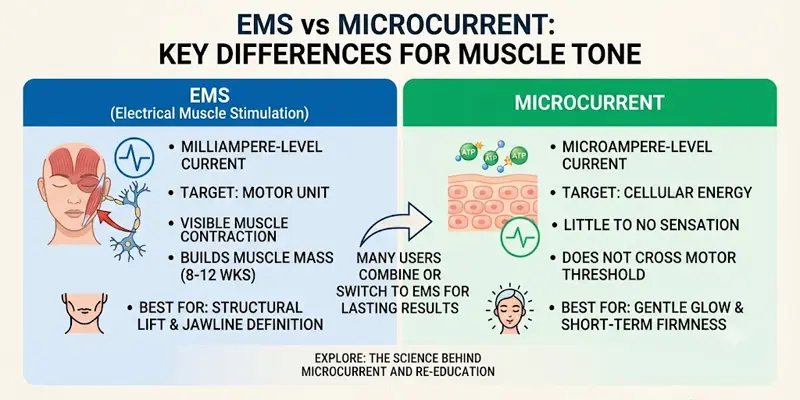
The at-home beauty device market has matured to the point where brand differentiation increasingly depends on the technology inside the device, not just the industrial design around it. For product managers building or expanding a beauty tool line, three technologies dominate the conversation: microcurrent, radio frequency (RF), and electrical muscle stimulation (EMS). In one sentence each: microcurrent uses low-intensity electrical currents to stimulate collagen and elastin production for a lifting and firming effect; RF delivers radio-frequency energy to warm the skin and support firmness and texture; and EMS uses electrical pulses to stimulate muscle contractions for a tightening effect.
This guide compares the three from a sourcing and product-line perspective, with representative device formats, a side-by-side comparison table, and selection criteria for brand teams evaluating an ODM/OEM partner.
---
Microcurrent: The Lifting and Firming Route
How it works
Microcurrent devices apply low-intensity electrical currents to the skin. This stimulation is designed to help the skin produce more collagen and elastin, and to support metabolism and blood circulation — the combination that underpins the lifting and firming positioning consumers associate with microcurrent tools.
Representative device formats
- MR-2319 — a three-in-one format combining lifting, firming, and magnetic massage. This is the kind of multi-function device that suits a brand wanting a single hero SKU with a clear "lift + firm + massage" story.
- MR-2367 Golden Leaf — a microcurrent gua sha tool with rapid hot-and-cold therapy. It uses a solar panel to generate microcurrent, measures 69.7 × 123.7 × 16.4 mm, and is built from PC and zinc alloy at 151 g. The solar-panel approach removes the need for a charging port, which simplifies waterproofing and use-case storytelling.
- MR-2338 — a four-dimensional sculpting device covering infusion, shaping, awakening, and massage. This format suits brands targeting a routine-based regimen rather than a single-function tool.
- YM-1837 — a 24K gold-plated gua sha device combining solar microcurrent with traditional gua sha. The gold plating and gua sha heritage give it a premium, ritual-oriented positioning.
Which brand positioning it fits
Microcurrent formats work well for brands positioned around lifting, contouring, and facial massage rituals — particularly premium skincare lines, gua sha-adjacent brands, and brands selling a "spa at home" routine. Solar-powered formats also appeal to brands targeting travel-friendly or water-adjacent use cases.
---
RF (Radio Frequency): The Firmness and Texture Route
How it works
RF devices deliver radio-frequency energy into the skin to produce controlled warming, which is designed to support firmness and skin texture over time. In at-home formats, RF is frequently combined with other technologies to broaden the claimed benefit set.
Representative device formats
- MR-2331 Dual-Head RF & EMS — a three-in-one device combining ultrasonic, EMS, and RF. The dual-head design allows the device to address different steps of a routine without requiring the user to switch tools.
- MR-1821 — an ultrasonic, RF, and EMS combination device designed for a full-face routine in 10–15 minutes. The time-bound routine claim is a useful anchor for consumer messaging and for retail packaging.
Which brand positioning it fits
RF-led devices suit brands targeting anti-aging and firmness claims with a more "clinical" or technology-forward tone. Combination formats (RF + EMS + ultrasonic) are well suited to brands that want a single device to carry multiple benefit claims, which can support a higher price tier and a more complex retail story.
---
EMS and Ultrasonic: The Tightening and Infusion Route
How it works
EMS (electrical muscle stimulation) uses electrical pulses designed to stimulate muscle contractions, supporting a tightening effect. Ultrasonic technology, often paired with ion technology, is used to support infusion and cleansing routines.
Representative device formats
- MR-2368 — an EMS and LED combination device with a 3D curved head. The curved head is designed to follow facial contours, and the LED element adds a visible technology cue that supports shelf appeal.
- BJ-1957 — a positive-and-negative ion device combined with EMS, positioned as a spa-grade format.
- BJ-1809 — a high-frequency ultrasonic device combined with positive-and-negative ion technology and EMS.
Which brand positioning it fits
EMS-led formats fit brands targeting tightening and contouring at accessible price points, as well as brands using LED as a visual differentiator. Ultrasonic and ion combinations suit brands building cleansing, infusion, or "spa-grade" ritual lines, often as part of a multi-step regimen rather than a single hero product.
---
Comparison Table
| Technology | Sensation | Best-fit product line | Development complexity |
|---|
|---|---|---|---|
| Microcurrent | Gentle, tingling, often described as a lifting massage | Premium lifting, contouring, gua sha, spa-ritual lines | Moderate — solar and multi-function formats add tooling and assembly considerations |
|---|---|---|---|
| RF | Warming | Anti-aging, firmness, technology-forward clinical-style lines | Higher — combination formats (RF + EMS + ultrasonic) require more integration work |
| EMS | Pulsing, muscle-contraction sensation | Tightening, contouring, LED-enhanced mass-market lines | Moderate — curved heads and LED integration affect tooling |
| Ultrasonic / Ion | Smooth, gliding, often paired with gel or serum | Cleansing, infusion, spa-grade regimen lines | Moderate to higher depending on combination count |
---
Four Selection Criteria for Brand Teams
1. Start from the claim, not the technology. Decide whether the product line needs to lead with lifting, firmness, tightening, or infusion, then select the technology that supports that claim. A microcurrent-led device and an RF-led device can both support firmness messaging, but they produce different user sensations and suit different price tiers.
2. Match device complexity to your price tier and retail channel. Single-function formats are simpler to explain on packaging and in short-form video. Multi-function formats such as MR-2331 or MR-1821 justify a higher price point but require clearer instruction design and more consumer education.
3. Consider the routine length your consumer will accept. A device designed for a 10–15 minute full-face routine, like MR-1821, fits consumers with an established regimen. A gua sha format like YM-1837 fits consumers who already perform a manual massage step and want to add technology to it.
4. Plan customization early. Color, logo, and packaging customization affect tooling timelines and MOQ planning. Bringing your ODM/OEM partner into the conversation at the concept stage avoids rework later in the development cycle.
---
OEM Customization: From Concept to Production
NICEMAY has been an ODM/OEM beauty device manufacturer since 2008. For brands developing a new beauty tool line, the process starts with your target claim, price tier, and channel. From there, the team supports customized color, logo, and packaging to align the device with your brand identity.
MOQ starts at 500 units. Standard samples are typically ready in 2–3 days, customized samples in 10–15 days, and mass production in 30–45 days. Compliance support is available for CE, FCC, and RoHS requirements, so your team can move from concept to shelf with fewer handoffs.
---
Discuss Your Device Idea
Whether your line is built around microcurrent lifting, RF firmness, EMS tightening, or a combination format, the right technology choice depends on your claim, your price tier, and your consumer's routine. Share your device concept with NICEMAY and the team will help you map it to a production-ready format — including customized color, logo, and packaging — with sampling and compliance timelines built in from the start.